Bilde

2026: Nancy L. Wicker: People in Scandinavian Viking-Age Art: Makers, Patrons, Consumers, and Subjects
2024: Helen Margetts : Artificial intelligence and the changing nature of government
2022: Simon Critchley: Mysticism
2021: Stephen M Gardiner: Defending Climate Justice in a Perfect Moral Storm
2018: Lorraine Daston: Seeing All At Once in Early Modern Science
2017: Nicholas Sims-Williams: From philology to history: Deciphering the language of ancient Afghanistan
2016: Rens Bod: How Interactions between Humanities and Science have Shaped our Knowledge
2015: Raquel Fernández: Women and Culture
2014: Tom Ginsburg: The Virtues of Evolution in an Age of Revolution: Norway's Enduring Constitution in Comparative Perspective
2013: Jürgen Kocka: Limits of Markets and States: Problems in the History of capitalism
2012: Steven Pinker: The history of violence
2010: Yash Ghai: Chimera of constitutionalism: State and society in developing countries
Akademiforelesningen i humaniora og samfunnsvitenskap er en årlig internasjonal forelesning. Den ble for første gang arrangert i mars 2009. I forlengelse blir det annethvert år arrangert et større symposium, det første fant sted i Vitenskapsakademiet i oktober 2009.
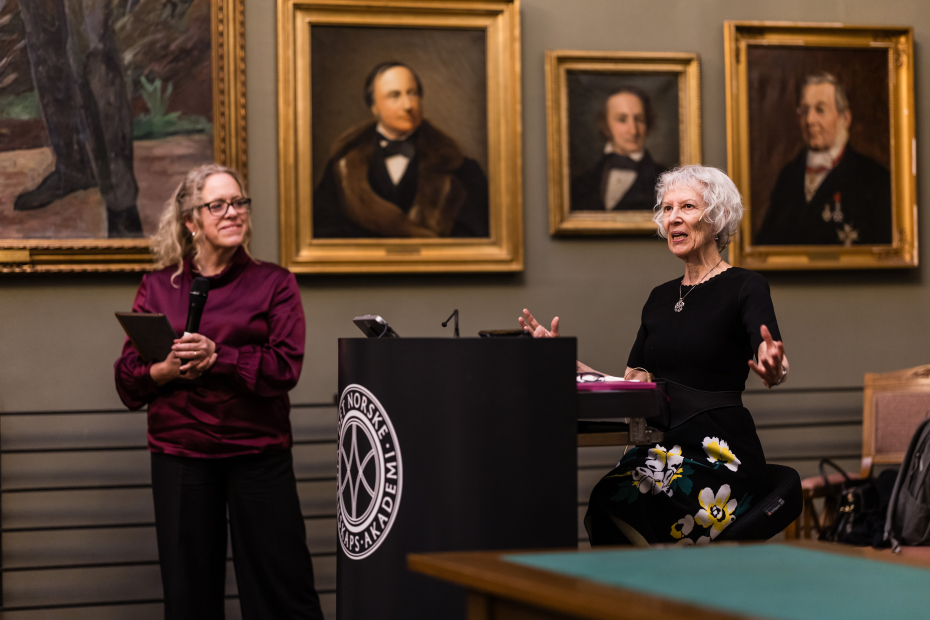
Akademiforelesningen 2026 ble holdt i Akademiet 23. mars.
Foredrag av professor Nancy L. Wicker, Distinguished Professor of Art History ved The University of Mississippi, Ole Miss. Hun snakket om "People in Scandinavian Viking-Age Art: Makers, Patrons, Consumers, and Subjects."
About the lecture
In my talk, I will examine artisans who made the art, patrons who sponsored it, and people who viewed and used (consumed) the products. In addition, I will consider figurative art and what we can learn from it about roles of humans in Viking society. Occasionally, contemporaneous runic inscriptions and later medieval written sources additionally inform us about the personal agency of artists, patrons, and users of the products, filling in gaps in what we know about personhood and individuals. I demonstrate what a holistic study of archaeological, art historical, and literary sources can reveal about craft workers, workshops, and finished products depicting animals and people.
Kristin B. Aavitsland og Nancy L. Wicker. Foto: Thomas B. Eckhoff/DNVA
Nancy L. Wicker is Distinguished Professor of Art History at The University of Mississippi and was awarded the Hensley Family Senior Professor Research Award there. She received the Ph.D. in interdisciplinary Ancient Studies from the University of Minnesota, combining studies of art history, archaeology, and Germanic philology. Before coming to Mississippi, Dr. Wicker was Professor of art history at Minnesota State University, Mankato, where she served as Director of Scandinavian Studies.*
She is the first woman elected to foreign membership in the Philosophical-historical Section of the Royal Society of Humanities at Uppsala, Sweden. She also is the first American elected to the International Sachsen Symposium, which focuses on early medieval archaeology of northern Europe.
Fellowships has supported her research, including from the American Council of Learned Societies, the American-Scandinavian Foundation, the Institute for Research in the Humanities, the National Humanities Center, the National Endowment for the Humanities, and the Samuel H. Kress Foundation.
Dr. Wicker is co-director of the collaborative digital humanities Project Andvari, which endeavors to create an iconographic thesaurus of early medieval art of northern Europe. The project has been funded by a Samuel H. Kress Foundation Digital Art History Grant and grants from the National Endowment for the Humanities. She has co-edited three books on gender and archaeology, collaborating with European colleagues.
She has served on governing boards of The Medieval Academy of America, the International Center of Medieval Art, the working party Archaeology of Gender in Europe, the Society for the Advancement of Scandinavian Study, and the International Symposium on Runes and Runic Inscriptions.
In her work, she focuses on artisans who made art, patrons who sponsored the works, men and women who used the objects, alongside human subjects that were depicted. Thus, she highlights the people of the Viking Age.